
See through the dark. Decide in real time.
Edge-deployed infrared video analytics that turns raw thermal and EO video into detected, tracked and classified targets — on the platform, with no cloud dependency.
From raw pixels to actionable intelligence.
Operators and autonomous platforms are drowning in video. Our software-first stack sits between the sensor and the decision-maker: it cleans up the thermal image, finds what matters, follows it, tells you what it is, and hands the result to your GCS or mission computer with frame-synchronous metadata.
It is modular, hardware-agnostic where practical, and designed to keep working when the link and the network do not.
- ISR
- Counter-UAS
- Border & perimeter
- Maritime
- UAV payloads
Six stages, sensor to screen.
Capture
720p to 4K · EO + IR, multi-channel
IR processing
Dead-pixel fix, NUC, calibration
Enhancement
CLAHE, denoise, scintillation mitigation
Detect & track
Multi-target, re-acquisition
Aided recognition
People, vehicles, drones, vessels
Display & data
Overlays, KLV/MISB, API output
Six modules. Use them together or one at a time.
Core core capability. Core + R&D includes R&D still in development.
-
Core
Detection & tracking
Real-time detection from moving or stationary platforms, with mission-selectable models rather than one fixed algorithm. Simultaneous multi-target tracks with motion prediction, re-acquisition after loss and long-duration persistence.
-
Core
Aided target recognition
Detections are routed to the right classifier: vehicle type and colour, fixed- vs rotary-wing drones, and an expandable class library for defence-specific categories as datasets mature.
-
Core + R&D
Infrared image processing
Dead-pixel removal and non-uniformity correction for thermal sensors. Software calibration workflows that aim to reduce reliance on a separate correction board, and absolute-amplitude IR snapshots where sensor data permits.
-
Core + R&D
Image enhancement
Selectable CLAHE, local-contrast and histogram methods. Real-time denoising tuned to preserve small-target detail on embedded hardware, plus atmospheric scintillation mitigation.
-
Core
Operator display
Configurable overlays for boxes, track IDs, class, confidence, coordinates and telemetry. Digital zoom with a quality/performance trade-off you control, and configurable false-colour palettes.
-
Core
Metadata & interoperability
Frame-synchronous KLV with MISB-compliant handling. Documented metadata APIs and standard network interfaces for GCS, VMS and mission systems — no custom connector per customer.
Target classes, expandable as datasets mature.
-
People
Detection of persons as the base capability. Attributes such as armed/unarmed, uniform type and posture are advanced R&D, image quality permitting.
-
Vehicles
Type (sedan, SUV, truck) and colour from day one. The architecture allows customer-defined defence classes, such as military trucks and armoured vehicles.
-
Drones
Fixed-wing vs rotary-wing classification. The class library extends as drone datasets mature, supporting counter-UAS workflows.
-
Vessels
Naval vs civilian categories, with an expandable vessel taxonomy for maritime surveillance.
Latency is a design target, not an afterthought.
- Telemetry latencybenchmark class
- 7–12 ms
- Glass-to-glass latencybenchmark class
- 110–250 ms
- Video inputmulti-channel
- 720p–4K
- Small-object detectionR&D target
- 2×2 px
These are engineering targets, not guarantees. Latency is measured module by module and glass to glass on the proposed hardware, with worst-case and percentile figures documented. Small-object detection depends on sensor resolution, range, contrast, atmospherics and training data.
Standard video in. Standard metadata out.
Video & transport
- H.264 / H.265 (MPEG-4 under evaluation)
- UDP, TCP, RTSP and multicast
- 720p, 1080p and 4K input
- Simultaneous EO and IR channels
Data & integration
- Frame-synchronous KLV / MISB metadata
- Documented metadata and control APIs
- Modular SDK: detect, track, enhance, encode
- GCS, VMS and mission-system interfaces
Edge deployment
- Runs on compact, power-efficient edge compute
- Fully offline during mission execution
- Hardware-abstracted, not locked to one GPU vendor
- Embedded Linux as the initial target
Resilient by design
- Recovers gracefully from video dropouts, malformed or late packets and temporary sensor interruptions.
- Secure software supply chain, authenticated updates, access control and secure configuration for defence deployments.
- Single-channel first, with architecture ready for multi-channel expansion.
- Reports CPU, GPU and NPU use, memory and power on target hardware, so you can size the platform.
Proven before it is delivered
- Detection precision, recall and FPS on an agreed test dataset
- Multi-target tracking, re-acquisition and persistence on agreed sequences
- Module-level and glass-to-glass latency against agreed thresholds
- Sustained stable operation on selected embedded hardware
- Live integration with one payload and one GCS or mission app
Run it on MYK sensors
- Persistent ISR
- Counter-UAS detection & tracking
- Border & perimeter surveillance
- Maritime & coastal watch
- UAV payload analytics
- GCS & mission-computer integration
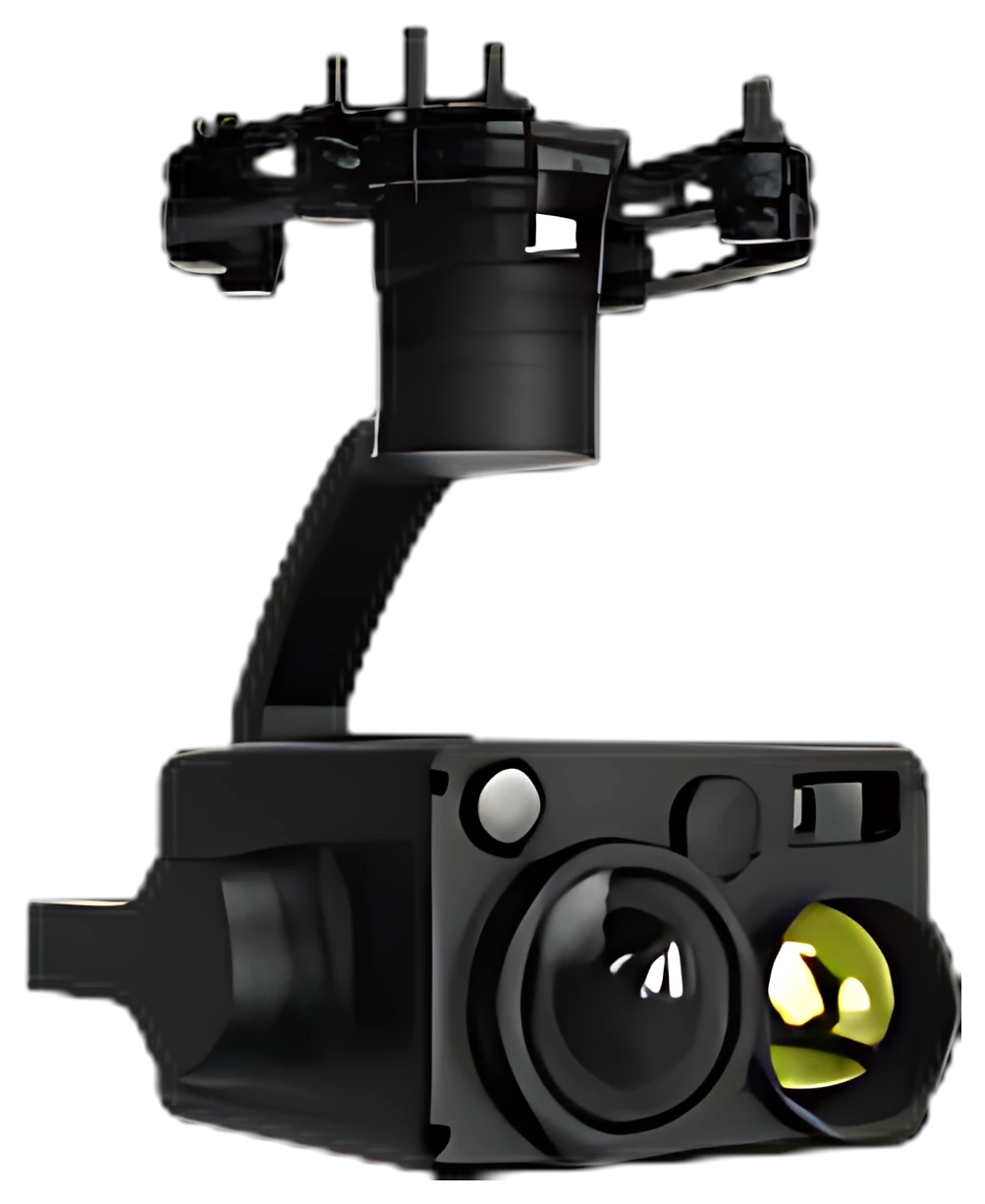
Gimbal Cameras
Five-Sensor Gimbal Camera
MYK/3A/5LG
- Thermal
- 640×512 · 35 mm
- Visible
- 2× 48 MP · 300× hybrid
- Laser ranging
- 1535 nm · 3 km

Thermal Camera Modules
MYK 1280 Thermal Imaging Core
MYK 1280×1024
- Resolution
- 1280×1024 · 12 µm
- NETD
- ≤30 mK
- Frame rate
- 25 / 30 / 50 Hz
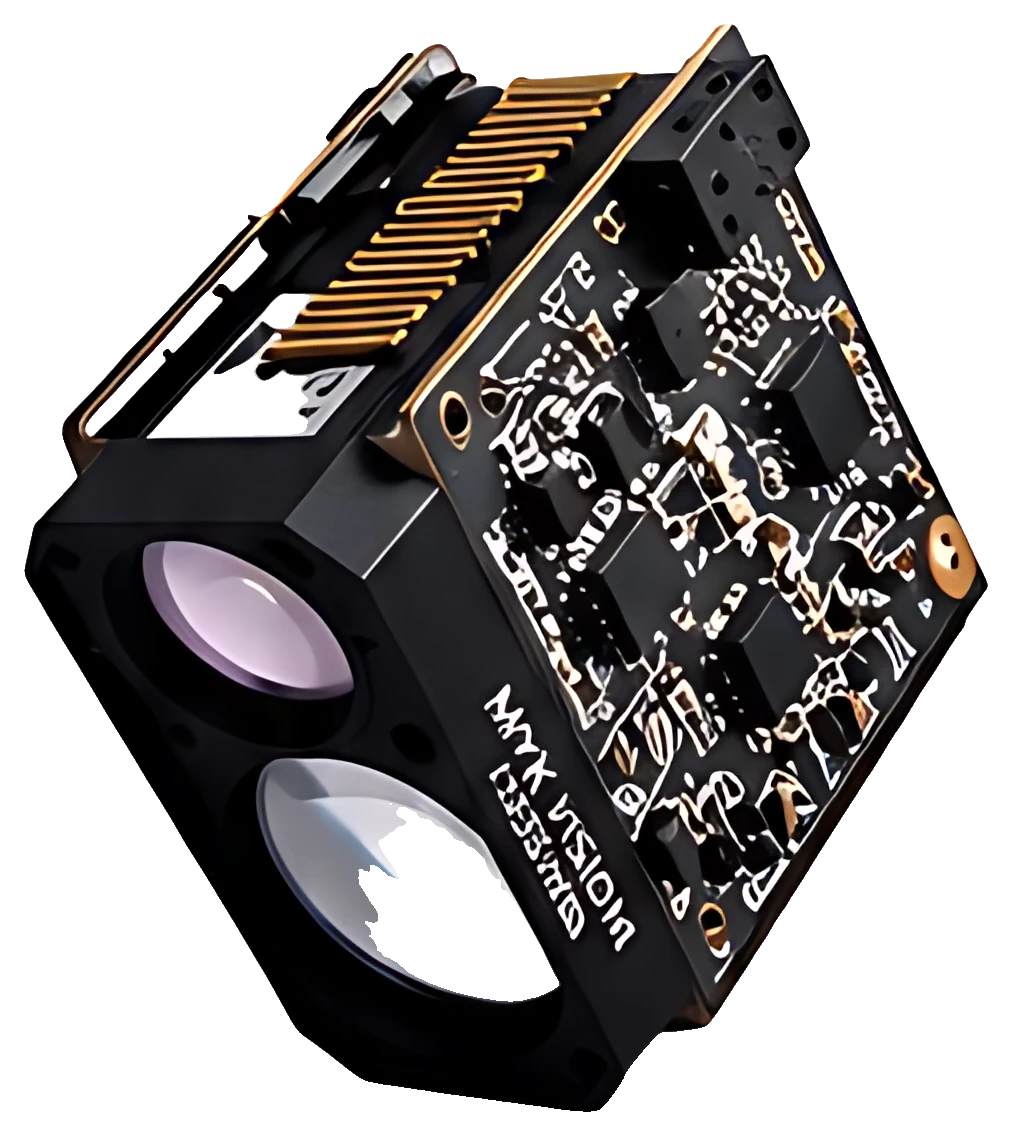
Laser Rangefinder Modules
MYK-1535/MB Compact Eye-Safe Laser Rangefinder
MYK-1535/MB
- Wavelength
- 1535 ± 5 nm
- Max range
- 10 – 4,000 m
- Accuracy
- ±1 m
Figures are design targets subject to validation on target hardware under agreed test conditions. Capabilities marked R&D are in development.
Questions about video analytics
Does MYK Vision video analytics need a cloud connection?
No. It is edge-deployed and runs on the platform, fully offline during mission execution.
What can it detect and recognise?
People, vehicles (type and colour), drones (fixed-wing or rotary-wing) and vessels (naval or civilian). Person detection is the base capability; attributes such as armed or unarmed are in R&D. The class library expands as datasets mature.
Which video and metadata formats does it support?
H.264 and H.265 video (MPEG-4 under evaluation) over UDP, TCP, RTSP and multicast, 720p to 4K input with simultaneous EO and IR channels, and frame-synchronous KLV metadata with MISB-compliant handling.
How fast is it?
Engineering targets are 7–12 ms telemetry latency and 110–250 ms glass-to-glass latency. These are targets, not guarantees, and are validated on the agreed hardware.
What hardware does it run on?
Compact, power-efficient edge compute. It is hardware-abstracted, not locked to one GPU vendor, with embedded Linux as the initial target.
How is it evaluated before delivery?
Through a pilot integration and an acceptance demonstration: detection precision, recall and FPS on an agreed dataset, tracking on agreed sequences, latency against agreed thresholds, stable operation on the selected hardware, and live integration with one payload and one GCS or mission application.
Evaluate it on your sensors, your platform, your missions.
Talk to MYK Vision about a pilot integration and acceptance demonstration.
- contact@mykvision.kr
- +82 10-8889-9102
- Mon–Fri, 09:00–18:00 KST